Friday, February 16, 2018

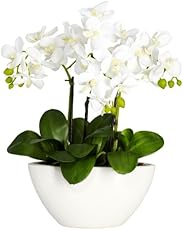
(Orchidaceae) Orchids in Florida at Crazy Critters Inc. $8-17 Proceeds Go To Non-Profit 501(C)(3) Exotic Animal Sanctuary

Orchids are exotic, beautiful, with thousands of species and as many hybrids, orchids are popular with homeowners and can be an obsession for the serious collector. And contrary to popular belief, they’re not difficult to grow.
Many orchids thrive in Florida’s heat and humidity and can do well in the home and around the yard.
Most orchids are epiphytes and they need special media in which to grow. Some of the most common ingredients in commercially available orchid mixes are chopped tree fern fiber, chopped fir tree bark, osmunda fiber, charcoal, and volcanic rock. These materials all help to create the loose, well-drained environment that orchids crave. For the most part, orchids need to be repotted every few years. Many can be divided into smaller plants at this time. Orchids typically prefer at least partial shade or filtered sunlight and should be protected from cold temperatures.

Orchids, Succulents, Cactus and Tropical Plants are all living organisms that interact with the body, mind, and home in ways that enhance the quality of life.

Temperature and Light:

Bright, indirect light is ideal for most orchid plant care. Southern and eastern exposure is optimal, as well as shady western light. Consequently, never place your Phalaenopsis orchid in full sun.
The foliage is always the best indicator of what your plant needs. Ideally, you want to see firm, light to medium green leaves. Limp, dark green leaves indicate that your orchid is not being exposed to enough light. On the other hand, too much light exposure will produce an excess of dark reddish pigmentation. You’ll want to remedy this quickly, as it can result in your Phalaenopsis producing fewer and even smaller blooms. Another way to tell if your plant is getting the optimal amount of light is seeing a very slight reddish hue near the base of the leaves. This lets you know that no more light is necessary!

 Watering:

One thing every orchid plant owner should understand is that, in its natural setting, most orchid attaches its roots to tree bark, and they are exposed. When exposed to frequent rainfall, the roots thoroughly absorb water and then dry out before they are watered again.
 When grown in a pot, it is easy to overwater an orchid plant. Of course, this can result in the roots rotting, causing the plant to wilt or die. A certain balance must be kept when watering your orchid. Most of all, you want to allow the roots to dry out a bit between watering; however, you never want the roots to be bone dry. Ideally, you should water the plant thoroughly early in the day.  Because as with all orchid plants you want the leaves to be dry by the evening. Much as, you never want to allow standing water on the soil, where the leaves emerge. Much as, filtered tap water is ideal, and should be cool or room temperature when administered (never cold)… think of rainwater!
 Most of all, water your plant with a gentle stream or spray and allow the pot to drain.
Furthermore, excess water should drain from the bottom of the plant’s pot, making sure the roots are wet, and to flush excess salt from the soil. Most noteworthy is the frequency of watering depends upon the light and temperature conditions. In warm, dry conditions, water every few days. Further, during cooler times of the year, since the roots will remain moist for a bit longer, go a little longer between watering.

 Humidity:

Most orchid plants come from tropical environments of 50-90% humidity. Therefore, dry air is definitely not ideal when caring for your orchid. Consequently, it may be the most challenging factor to control indoors, especially during winter, when heaters are run, and the air is generally very dry.

Microfoggers and humidifiers are a simple solution if you keep your plant in an enclosed area.

If you keep your orchid plant on a windowsill or larger room, you can try grouping plants together. As a result, they will develop their own microclimate. While using humidity grow trays to collect excess water from watering your plants.  In addition, place your orchid pot in a shallow tray or saucer filled with pebbles and water. Furthermore, be sure to place the pot on the pebbles and not in the water, since orchids do not prefer wet roots.
Especially relevant air circulation is also an important factor to consider.  While Phalaenopsis orchids grow higher up off the ground, on trees, where there is constant air flow. Opposite there are many orchids that grow on the ground in deep jungles.

Whether you are human or animal, there are so many benefits to living around plants.

Here’s a list from the American Orchid Society that gives a general outline growing requirements for orchids that do well outside in Florida:
  • Cattleya Alliance Hybrid is the showy corsage variety, especially Laelia anceps, and requires half sun. It’s temperature-tolerant.
  • * Phalaenopsis is great for beginners and does well in full shade.
  • * Dendrobiums: The Indian and Australian types are best, requiring half sun. They are temperature tolerant.
  • * Vanda flowers in summer months and takes a lot of suns.
  • * Epidendrums, especially the brilliant reed-stem types, do fine in South Florida. They need almost full sun but are temperature tolerant.
  • * Oncidiums: Choose the Mexican species, or higher-elevation types, with light requirements of bright shade to half sun.
  • * Paphiopedilums are slippered orchids and fare best in shaded gardens.
  • * Spathoglottis have broad, palm-like leaves and spikes of purple and yellow flowers. Grow them in shade to half sun.


We Adopt ~ Breed ~ Rescue ~ Transport  ~ Rehabilitate
Crazy Critters Inc. is a Private Non-Profit, 501(c)3, Exotic Animal Rescue and Sanctuary. Our Wildlife Facility is located in Eustis, Florida. We provide permanent homes to over 200 animals including lizards, turtles, skinks, geckos, birds, and assorted wildlife. Crazy Critters Inc. was established to provide non-domestic, non-releasable animals with a safe and permanent home.
Mostly Tortoises and Turtles call Crazy Critters Inc. home. What makes us unique is that after adoption, Crazy Critters Inc. continues to share the lives of the pets on social media. Providing an additional continued connection. When an animal finds its way to Crazy Critters, it has found a forever home.
Everyone in our community benefits when donors put their funds together to help protect animals and our environment. And the fact that the animals can call this a forever home makes it that much better. Your monetary donations help provide veterinary care, food, and supplies to the animals in our care.
In keeping with our commitment to a quality life for the animals here at the sanctuary, we provide a diet created specifically for each animal’s needs, the best veterinary care, enrichment programs for the animals, and maintain their spacious, safe habitats.
Click DONATE to make a safe Paypal Transaction, of any amount. Every single dollar adds up! We will contact you by email to see how you would like your sponsorship recognized. We appreciate our community! We are always looking for corporate sponsors who believe in a mission such as ours


REMEMBER: All donations are tax-deductible!

We Grow Crazy Plants To Care For Crazy Critters!

Feel free to contact us with questions requests and comments.
Follow us on our journey as we build our Herp Haven called Crazy Critters!
Website
Facebook 
Instagram 
YouTube
GoFundMe
We even have a blog!

Please like, share, follow and subscribe.

Wednesday, February 14, 2018

Big Boi and Bernie the Spur Thigh Tortoises, meet for the first time at ...

African Spur Thigh Tortoises like to quarrel by nature. They are either going to get along or not. And if you ask them again in a minute, they will have changed their minds. Combat is in their genetics. So instead of trying to force them on each other, we have found that allowing them to tell us who they want to get along with is better. Better for the fence and the tortoise.
For instance. Jamie, when he got here we were asked to try to get his two girls (10 years together as a group) to live with a smaller male. Which makes sense because Jamie is so very large. However, when we did put the girls in another place, Jamie walked the fence all day, none stop. Even though he could not see the females he could smell them. The females seemed agitated also. Or at least that is what we witnessed. After a few days of this, Ken took the girls and put them in his yard. This made him stop. Right away. He stopped pacing. We think we will take the girls out a lil’ bit at a time.
In this video, you meet Sweet Lil Bernie. She is so new to Crazy Critters Inc. This is her first time walking around. Ken put her with Big Boi together in one of the small areas. And they seem to get along. As matter of fact, they may even be from the same region. They look very similar. Big Boi smelled Bernie and even bit at her. They are not mean bites. It is a behavior you might notice while viewing the video. To us, the behaviors are much like when you bring a new puppy into the home. The tortoise we call Big Boi has been here the longest at six years. he is just smelling and nipping (but not nipping, you guys know what we are saying!)
The video is sped up 7x’s. We had to walk away and not film any longer because the weather was so cold and we wanted the tortoises to feel comfortable so they could eat and poop. Yes, I said poop. Because it is either poo while they are outside or in their night tubs. And that is better to be avoided if possible!
The African Sulcata Tortoise (Geochelone sulcata) can reach more than 200 pounds in weight and 36 inches in length. Its shape is round, with a tan-colored, patternless shell that is more flat than domed. The word “sulcata” comes from the Latin word sulcus, meaning a groove or furrow. In regard to the sulcata tortoise, this refers to the distinctive growth rings that are produced as the tortoise’s scutes grow with each seasonal cycle. New shell growth that appears around each scute begins as dark brown in coloration but usually fades to a straw color as it is bleached by the sun over the years as the tortoise matures.
There is a noticeable difference between male and female African Sulcatas, but it does not become evident until they are at least 10 to 15 pounds or larger. Males develop a concave plastron with anal scutes that form a “V” where the tail protrudes. A female’s shell is usually not as round in appearance when compared to a male. The plastron of a female is also flat, with anal scutes that form more of a “U” shape where the tail protrudes to allow the passing of eggs. A female’s tail is much shorter than a male’s, and all these sexual characteristics become more pronounced as the tortoises get bigger in size.
The home range of Sulcata is an approximately 250-mile-wide strip of land that sits just north of Ethiopia. This relatively narrow strip of territory traverses the North African continent roughly corresponding with the transition zone between the Sahara Desert and the savannah/forest area known as the Sudan region that lies south of the Sahara. This transition zone is called the Sahel. This is a very unique biozone that features short shrubs, grasses, and dwarfed trees. It is not quite desert and not quite a savannah.
Because of its location, the Sahel can be a desert environment during some years, and Savannah during others, depending on the prevailing weather patterns. During any given year, it can receive 5 to 20 inches of rain, usually during the monsoon season that typically lasts from July to November. The Sahel is not only a transitional zone for the weather between the desert and the Sudan region, but it is also one in regard to soil fertility, as well. The soil of the Sahel is only slightly more fertile than the desert but less so than the Sudan region. This is important because even during times of plentiful rain, the vegetation of the Sahel remains stunted because of the soil’s low fertility.
Sulcata tortoises dig extensive burrows during the monsoon season, in preparation for when they will need to seek refuge from the extreme heat of the dry season, as well as escape from the high midday temperatures that occur during the rest of the year. Sulcata burrows can extend horizontally well over 30 feet, with a vertical depth of more than 20 feet in many cases. The depth of a burrow provides a safe environment with relatively stable temperatures for a tortoise, despite the huge temperature fluctuations that occur outside of the burrow. The depth of the burrow also provides humidity levels that are commonly over 50 percent. Sulcata burrows are much like the Florida Gopher Tortoise in that it usually includes multiple chambers and connecting tunnels,
After the wet season, they will feed on almost any organic matter they can find, including dried plants and leaves that remain during the dry season.  Like most tortoises, sulcatas are opportunistic feeders in the wild. They feed mostly on the abundant growth that follows the rainy season, consuming grasses, broadleaf weeds, leaves and fruit from trees and bushes. During times of little to no plant growth, sulcatas have been known to also consume small branches, tree bark, animal feces, and carrion.
During the height of the dry season, sulcatas remain mostly inactive, and they are seldom if ever, seen outside their burrows. When the rainy season arrives they will emerge to forage and replace lost reserves for reproduction. Breeding and egg-laying usually take place at this time, although there is not an exclusive breeding season. It has been reported that nesting in the wild often occurs at the base of bushes. Low population densities of male sulcatas result in breeding throughout the year, whenever a male encounters a female (which is not very often). Most of these encounters occur most frequently during the beginning of the rainy season and toward the end when sulcata tortoises are the most active.  A female African Spur-Thigh Tortoise may lay as many as 24 eggs, though fewer are usually deposited. This typically occurs from November to May.
African Spurred Tortoise, is surpassed in size only by the giant tortoises of the Galapagos Islands and Seychelles. Not only do these tortoises grow very large, but they also grow very rapidly up to two and a half feet long and 80-110 pounds or more.  If you need a home for your tortoise or other exotic please drop us a line, we will contact you back within hours.
We Adopt ~ Breed ~ Rescue ~ Transport  ~ Rehabilitate
Crazy Critters Inc. is a Private Non-Profit, 501(c)3, Exotic Animal Rescue and Sanctuary. Our Wildlife Facility is located in Eustis, Florida. We provide permanent homes to over 200 animals including lizards, turtles, skinks, geckos, birds, and assorted wildlife. Crazy Critters Inc. was established to provide non-domestic, non-releasable animals with a safe and permanent home.
Mostly Tortoises and Turtles call Crazy Critters Inc. home. What makes us unique is that after adoption, Crazy Critters Inc. continues to share the lives of the pets on social media. Providing an additional continued connection. When an animal finds its way to Crazy Critters, it has found a forever home.
Everyone in our community benefits when donors put their funds together to help protect animals and our environment. And the fact that the animals can call this a forever home makes it that much better. Your monetary donations help provide veterinary care, food, and supplies to the animals in our care.
In keeping with our commitment to a quality life for the animals here at the sanctuary, we provide a diet created specifically for each animal’s needs, the best veterinary care, enrichment programs for the animals, and maintain their spacious, safe habitats.
Click DONATE to make a safe Paypal Transaction, of any amount. Every single dollar adds up! We will contact you by email to see how you would like your sponsorship recognized. We appreciate our community! We are always looking for corporate sponsors who believe in a mission such as ours


REMEMBER: All donations are tax-deductible!

We Grow Crazy Plants To Care For Crazy Critters!

Feel free to contact us with questions requests and comments.
Follow us on our journey as we build our Herp Haven called Crazy Critters!
Website
Facebook 
Instagram 
YouTube
GoFundMe
We even have a blog!

Please like, share, follow and subscribe.